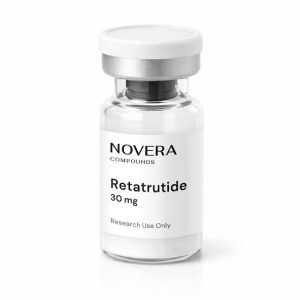
Retatrutide represents a breakthrough in peptide-based research, distinguished by its unique ability to simultaneously target three metabolic receptors: GIP, GLP-1, and glucagon. This triple-agonist mechanism unlocks a spectrum of benefits that extend beyond those achievable with single or dual agonists, offering unprecedented insights into metabolic regulation and cardiometabolic health.
Unprecedented Weight Reduction
The most striking benefit of retatrutide is its unparalleled efficacy in reducing body weight. Phase 3 clinical data demonstrate that retatrutide achieves weight loss outcomes that rival those historically associated with bariatric surgery . In the TRIUMPH-1 trial, participants receiving the 12 mg dose achieved an average weight reduction of 28.3% (70.3 lbs) at 80 weeks . A prespecified extension to 104 weeks showed continued improvement, with participants reaching an average total weight loss of 30.3% (85.0 lbs) .
These outcomes substantially exceed those reported for existing metabolic agents. In the phase 2 clinical trial, retatrutide demonstrated a mean body weight reduction of 24.2% at 48 weeks, with 92% of participants achieving at least 5% weight loss and 83% achieving reductions of 15% or greater . Notably, 65.3% of participants on the 12 mg dose reduced their BMI below the obesity threshold (BMI < 30 kg/m²) by week 80, including 37.5% of those who entered the trial with class 3 obesity (BMI ≥ 40 kg/m²) .
The mechanistic basis for this superior efficacy lies in retatrutide’s triple-agonist design. While GLP-1 agonism suppresses appetite and delays gastric emptying, the addition of GIP and glucagon receptor activation introduces complementary pathways that enhance energy expenditure and promote fat metabolism . Preclinical research confirms that retatrutide’s sustained weight loss is driven by mechanisms beyond chronic appetite suppression, such as enhanced energy expenditure, rather than caloric restriction alone .
Superior Glycemic Control
For individuals with type 2 diabetes, retatrutide offers powerful glycemic benefits that complement its weight-reducing effects. In the TRANSCEND-T2D-1 phase 3 trial, participants achieved average A1C reductions of up to 2.0 percentage points from a baseline of 7.9% . Up to 90% of participants reached an A1C below 7.0%, aligning with established glycemic targets, and up to 46% achieved an A1C below 5.7%, the threshold for normoglycemia .
These results are particularly noteworthy for a diabetes population, as weight reduction with existing therapies is often less pronounced in individuals with type 2 diabetes compared to those without the condition . In the TRANSCEND-T2D-1 trial, participants receiving the 12 mg dose lost an average of 36.6 lbs (16.8%) over 40 weeks, with weight loss showing no signs of plateauing . The ability to achieve substantial weight loss alongside robust glycemic control addresses a critical gap in metabolic management .
Cardiovascular and Cardiometabolic Benefits
Retatrutide demonstrates a comprehensive cardiometabolic benefit profile that extends well beyond weight and glucose management. In the TRIUMPH-1 trial, participants experienced substantial improvements across key cardiovascular risk factors, including a 41% reduction in triglycerides, a 24.2% reduction in non-HDL cholesterol, a 12.3 mmHg reduction in systolic blood pressure, and a 9.5-inch (24.1 cm) reduction in waist circumference . In TRANSCEND-T2D-1, similar improvements were observed with reductions of up to 39.6% in triglycerides and 6.4 mmHg in systolic blood pressure .
These findings are further supported by the TRIUMPH-3 trial, which enrolled participants with severe obesity and established cardiovascular disease. At 80 weeks, participants on the 12 mg dose experienced average reductions of 37.0% in triglycerides, 16.5% in non-HDL cholesterol, 9.3 mmHg in systolic blood pressure, and a 51.2% reduction in high-sensitivity C-reactive protein (hsCRP) . These improvements in lipid profiles, blood pressure, and inflammatory markers suggest substantial potential for cardiovascular risk reduction.
Improvements in Obesity-Related Complications
Retatrutide has shown meaningful benefits for serious obesity-related conditions, including knee osteoarthritis pain and obstructive sleep apnea. In the TRIUMPH-1 trial’s nested basket studies, participants with knee osteoarthritis experienced a reduction of up to 4.3 points (73.1%) in WOMAC pain scores from a baseline of 6.0 . For those with moderate-to-severe obstructive sleep apnea, retatrutide reduced the apnea-hypopnea index by up to 36.1 events per hour (60.6%) from a baseline of 58.6 events per hour . The ability to address these obesity-related complications highlights retatrutide’s potential to improve quality of life and functional outcomes.
Adipose Tissue Remodeling and Metabolic Reprogramming
Beyond the quantitative outcomes of weight loss, retatrutide actively reverses adipose tissue dysfunction at the molecular level. Multi-omic profiling reveals that retatrutide induces coordinated changes in gene expression governing lipid turnover, mitochondrial biogenesis, and extracellular matrix remodeling . In preclinical models, retatrutide upregulated genes involved in lipolysis (Pnpla2/ATGL, Lipe/HSL) and mitochondrial oxidative capacity (Ppara, Ppargc1a), shifting adipocytes from a lipid-storing to an energy-dissipating phenotype .
These findings demonstrate that retatrutide’s benefits extend beyond simple caloric reduction, with direct actions on adipose tissue biology that contribute to sustained metabolic improvement. The glucagon receptor component of retatrutide’s mechanism is particularly important in this context, as glucagon activation promotes lipolysis, fatty acid oxidation, and energy expenditure while modulating hepatic glucose production .
Conclusion
Retatrutide’s triple-agonist mechanism establishes a new benchmark in metabolic research, delivering benefits across multiple dimensions: unprecedented weight reduction, superior glycemic control, comprehensive cardiovascular improvements, and meaningful effects on obesity-related complications. The robust clinical evidence from phase 3 trials, combined with mechanistic insights from preclinical research, positions retatrutide as a transformative compound with the potential to reshape approaches to metabolic management . As research continues to elucidate the full scope of GIP, GLP-1, and glucagon receptor co-agonism, retatrutide remains at the forefront of scientific discovery, offering valuable insights into integrated metabolic regulation and the future of multi-targeted peptide therapeutics.
You can buy Retatrutide without prescription at www.teslarxgear.com
 Tirzepatide – buy in UK and Europe without prescription